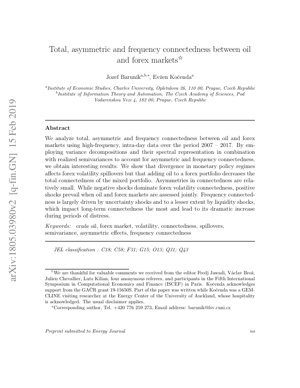
Total, Asymmetric and Frequency Connectedness Between Oil and Forex Markets
Analysis of volatility spillovers between crude oil and foreign exchange markets using high-frequency data, variance decompositions, and spectral methods to uncover asymmetric and frequency-dependent connectedness.
Home »
Documentation »
Total, Asymmetric and Frequency Connectedness Between Oil and Forex Markets
1. Introduction
This research provides a comprehensive analysis of volatility connectedness (spillovers) between crude oil and foreign exchange (forex) markets. The nexus is critical because most oil is priced and traded in US dollars, creating an intrinsic link between oil price volatility and currency exchange rate fluctuations. The study employs high-frequency intra-day data from 2007 to 2017 and innovatively decomposes connectedness into total, asymmetric (positive vs. negative shocks), and frequency-dependent (short vs. long-term) components. The goal is to quantify how uncertainty transmits between these two pivotal financial markets, with implications for risk management, portfolio diversification, and monetary policy analysis.
2. Methodology & Data
The analysis is built on a robust econometric framework combining realized volatility measures, variance decompositions, and spectral (frequency) analysis.
Forex Market: Exchange rates for major currencies (EUR, GBP, JPY, etc.) against the USD, also at high frequency.
Core Variable: Realized volatility (RV) calculated from intra-day returns, serving as the measure of market uncertainty.
Decomposition: Realized semivariances ($RS^+$ and $RS^-$) are computed to capture volatility due to positive and negative returns separately, enabling asymmetry analysis.
2.2. Total Connectedness Framework
The study adopts the Diebold and Yilmaz (2012, 2015) spillover index framework based on Vector Autoregressive (VAR) models and forecast error variance decompositions (FEVD). The Total Connectedness Index quantifies the proportion of forecast error variance in all variables coming from spillovers, as opposed to idiosyncratic shocks.
2.3. Asymmetric & Frequency Decomposition
This is the paper's key methodological contribution:
Asymmetric Connectedness: By feeding realized semivariances ($RS^+$, $RS^-$) into the connectedness framework, the authors separate spillovers from "good volatility" (positive returns) and "bad volatility" (negative returns).
Frequency Connectedness: Using the spectral representation of variance decompositions by Baruník and Křehlík (2018), the total connectedness is decomposed into components associated with different frequency bands (e.g., short-term: 1-5 days, long-term: >20 days). This reveals whether spillovers are transient or persistent.
3. Empirical Results
3.1. Total Connectedness Dynamics
The total volatility connectedness between oil and forex markets is significant and time-varying. Key findings:
Spillovers intensify dramatically during periods of financial distress (e.g., the 2008 Global Financial Crisis, the 2014-2016 oil price crash).
Divergence in global monetary policy regimes (e.g., Fed tapering) is a key driver of increased forex volatility spillovers.
Portfolio Insight: Adding oil to a pure forex portfolio decreases the overall connectedness of the portfolio. This suggests oil can act as a diversifier that reduces the portfolio's internal vulnerability to cross-market spillovers.
3.2. Asymmetric Spillover Effects
The magnitude of asymmetric effects is found to be relatively small on average, but the direction is revealing:
Within the forex market alone, spillovers from negative shocks (bad volatility) dominate those from positive shocks.
When oil and forex markets are analyzed jointly, positive shocks (good volatility) generate stronger spillovers. This indicates that positive oil market developments might propagate optimism or risk-on sentiment across to currencies.
3.3. Frequency-Dependent Connectedness
This analysis yields perhaps the most nuanced insights:
Long-term connectedness (associated with lower frequencies) is the most dominant component and exhibits the most dramatic surges during crises.
Primary Driver: Long-term connectedness is largely driven by uncertainty shocks (e.g., geopolitical events, structural demand changes).
Secondary Driver:Liquidity shocks also impact long-term connectedness, but to a lesser extent.
Short-term connectedness is more stable and linked to high-frequency trading and transient news.
4. Key Insights & Implications
Risk Management
The dominance of long-term spillovers during crises suggests risk models must account for low-frequency, persistent channels of volatility transmission, not just short-term correlations.
Portfolio Strategy
Oil's role in reducing portfolio connectedness validates its use as a diversifier in multi-asset portfolios containing currencies, especially during periods of monetary policy divergence.
Policy Analysis
Central banks, especially in commodity-exporting nations, must consider the feedback loop from oil volatility to currency stability, which operates primarily through long-term expectations.
5. Technical Framework & Analysis
5.1. Mathematical Foundation
The core of the frequency connectedness rests on the spectral decomposition of the variance-covariance matrix. For a $K$-variable VAR($p$) system: $\mathbf{Y}_t = \sum_{i=1}^p \Phi_i \mathbf{Y}_{t-i} + \epsilon_t$, with $\epsilon_t \sim (0, \Sigma)$. The spectral density of $\mathbf{Y}_t$ at frequency $\omega$ is: $S_{\mathbf{Y}}(\omega) = \Psi(e^{-i\omega}) \Sigma \Psi'(e^{+i\omega})$, where $\Psi(e^{-i\omega})$ is the Fourier transform of the MA($\infty$) coefficients. The share of the forecast error variance of variable $j$ attributable to shocks in variable $k$ at frequency $\omega$ is given by a spectral version of the FEVD:
where $\Psi_h(\omega)$ are the frequency-response functions. The connectedness measure within a specific frequency band $d = (a, b)$ is then obtained by integrating $\theta_{j,k}(\omega)$ over that band.
5.2. Analytical Framework Example
Case Study: Analyzing the 2014 Oil Price Crash
Objective: Determine how volatility spilled from oil to the Canadian dollar (CAD/USD) and Norwegian krone (NOK/USD) during the 2014-2016 period, distinguishing between short-term trading effects and long-term structural impacts.
Data Preparation: Calculate 5-minute realized volatility and semivariances for WTI, CAD/USD, and NOK/USD.
Model Estimation: Estimate a daily VAR model for the vector $[RV_{Oil}, RV_{CAD}, RV_{NOK}]$ and separately for $[RS^+_{Oil}, RS^+_{CAD}, ...]$ and $[RS^-_{Oil}, RS^-_{CAD}, ...]$.
Frequency Decomposition: Apply the Baruník-Křehlík spectral decomposition to the variance-covariance matrix from the total RV VAR. Define bands: Short-term (1-5 business days), Medium-term (5-20 days), Long-term (20+ days).
Interpretation:
If spillovers from Oil to CAD are strongest in the Long-term band, it suggests the crash impacted Canada's terms of trade and long-run economic outlook, driving sustained CAD volatility.
If the Asymmetric analysis shows $RS^-$ spillovers dominate, it confirms the crisis was driven by negative shocks propagating fear.
Comparing the Total Connectedness of a portfolio [CAD, NOK] vs. [CAD, NOK, Oil] would likely show a decrease, illustrating the diversification benefit.
6. Future Research & Applications
Integration with Alternative Data: Future studies could incorporate news sentiment scores (from NLP models) or options-implied volatility surfaces to predict regimes of high asymmetric or frequency-connectedness.
Machine Learning Enhancement: Techniques like Long Short-Term Memory (LSTM) networks could be used to model the non-linear dynamics of connectedness, potentially capturing regime switches more effectively than linear VAR models.
Climate Risk & Energy Transition: This framework is perfectly suited to analyze volatility spillovers between carbon credit markets (e.g., EU ETS), renewable energy stocks, and related currencies (EUR, AUD), as the energy transition accelerates.
Decentralized Finance (DeFi): Applying this methodology to the volatility of cryptocurrency "oil proxies" (e.g., tokenized commodities) and forex pairs on decentralized exchanges could reveal novel spillover patterns in nascent digital asset markets.
Real-Time Risk Dashboard: The methodology can be operationalized into a dashboard for asset managers, providing real-time monitoring of cross-asset volatility transmission channels, segmented by frequency and shock sign.
7. References
Baruník, J., & Křehlík, T. (2018). Measuring the frequency dynamics of financial connectedness and systemic risk. Journal of Financial Econometrics, 16(2), 271-296.
Diebold, F. X., & Yilmaz, K. (2012). Better to give than to receive: Predictive directional measurement of volatility spillovers. International Journal of Forecasting, 28(1), 57-66.
Diebold, F. X., & Yilmaz, K. (2015). Financial and macroeconomic connectedness: A network approach to measurement and monitoring. Oxford University Press.
Fattouh, B., Kilian, L., & Mahadeva, L. (2013). The role of speculation in oil markets: What have we learned so far? The Energy Journal, 34(3).
Ferraro, D., Rogoff, K., & Rossi, B. (2015). Can oil prices forecast exchange rates? An empirical analysis of the relationship between commodity prices and exchange rates. Journal of International Money and Finance, 54, 116-141.
Goodfellow, I., Pouget-Abadie, J., Mirza, M., Xu, B., Warde-Farley, D., Ozair, S., ... & Bengio, Y. (2014). Generative adversarial nets. Advances in neural information processing systems, 27. (Cited as an example of advanced methodological frameworks in adjacent fields).
Kilian, L., & Zhou, X. (2018). Oil prices, exchange rates and interest rates. Journal of International Money and Finance, 86, 1-15.
Analyst's Perspective: A Four-Step Deconstruction
Core Insight
This paper delivers a crucial, often-overlooked truth: the connection between oil and forex isn't just about price co-movement; it's a complex, multi-layered transmission of uncertainty. The most valuable finding isn't that spillovers exist—that's table stakes. It's that these spillovers are predominantly long-term and structural in nature. During crises, it's not the high-frequency noise that links a falling oil price to a weakening Canadian dollar; it's the market's grim reassessment of Canada's long-term fiscal health and export prospects. This shifts the narrative from tactical trading to strategic risk assessment.
Logical Flow
The authors' logic is admirably surgical. They start with the established Diebold-Yilmaz spillover index—a workhorse in the field—but refuse to stop at a single aggregate number. Recognizing that a "total" measure can mask critical dynamics (akin to how an average temperature hides a heatwave), they perform a double decomposition: first by the sign of the shock (asymmetry), then by its time horizon (frequency). This is reminiscent of the methodological rigor in seminal works like Baruník and Křehlík's own 2018 paper, which argued that financial connectedness has a "term structure." The flow from aggregate -> asymmetric -> frequency creates a progressively sharper diagnostic tool, isolating the specific "when" and "how" of volatility transmission.
Strengths & Flaws
Strengths: The methodological synthesis is first-rate. Combining realized semivariance (for asymmetry) with spectral decomposition (for frequency) is a powerful innovation. The portfolio diversification finding—that oil reduces overall connectedness—is a concrete, actionable insight that directly challenges simplistic views of oil as a pure risk amplifier. The use of high-frequency data provides granularity that lower-frequency studies miss.
Flaws: The paper's main weakness is its reliance on a linear VAR framework. Financial market spillovers, especially during crises, are notoriously non-linear and prone to sudden regime shifts. While the frequency decomposition adds nuance, the underlying model may still oversimplify the tail-dependent relationships that matter most for risk management. The authors nod to this limitation but do not address it empirically. Furthermore, the analysis of "why" behind the frequency results (e.g., identifying specific uncertainty vs. liquidity events) remains somewhat interpretive; a more formal narrative event study could strengthen causality claims.
Actionable Insights
For practitioners, this research mandates a shift in mindset and tooling:
Ditch the Single Metric: Risk teams must stop relying on a single correlation or beta between oil and currencies. They need to implement monitoring for long-term volatility beta, which this paper shows is the primary crisis channel.
Re-evaluate Hedging Strategies: The finding that positive oil shocks can dominate spillovers in a mixed portfolio suggests that hedging strategies based solely on downside protection (e.g., put options) may be incomplete. Strategies need to account for the asymmetry in volatility transmission.
Factor This into FX Models: Currency strategists, particularly for commodity exporters (CAD, AUD, NOK, RUB), must explicitly model long-horizon oil volatility as an input for fair value and risk forecasts. It's not just the spot oil price that matters, but the market's uncertainty around its future path.
Central Bank Implications: For central banks like the Bank of Canada, this research underscores that oil volatility is a core component of financial stability monitoring, not just an external commodity shock. Their stress tests should incorporate scenarios of sustained, high long-term oil volatility and its propagation through the forex market into domestic financial conditions.
In essence, Baruník and Kočenda have provided the financial industry with a more sophisticated lens. The question is no longer if oil and forex volatility are linked, but over what time horizon and under what market conditions that link is strongest. Ignoring this dimensionality is, frankly, a strategic blind spot.