Table of Contents
1. Introduction & Overview
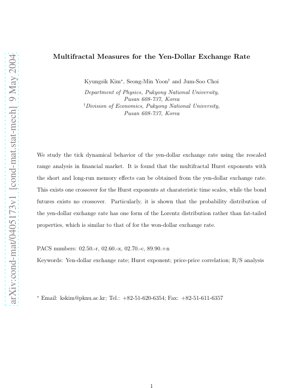
This paper investigates the multifractal properties of high-frequency (tick) data for the yen-dollar (JPY/USD) exchange rate. Operating within the field of econophysics, it applies methods from statistical physics—specifically Rescaled Range (R/S) analysis—to characterize the scaling behavior, memory effects, and distribution of returns in this major financial time series. The study aims to uncover whether the dynamics exhibit persistent or anti-persistent behavior and to identify the functional form of the return distribution, contrasting it with other currency pairs like the won-dollar (KRW/USD) rate.
2. Methodology & Theoretical Framework
The core analytical tool is the R/S analysis, a non-parametric method used to estimate the Hurst exponent ($H$), which quantifies the long-range dependence in a time series.
2.1 R/S Analysis for Hurst Exponents
The R/S statistic is calculated for sub-series of the return data. For a time series of returns $r(\tau)$ of length $n$, divided into $N$ subseries of length $M$, the rescaled range $(R/S)_M(\tau)$ is computed. The Hurst exponent is derived from the scaling relation: $(R/S)_M(\tau) \propto M^H$. An $H > 0.5$ indicates persistent (trend-reinforcing) behavior, $H < 0.5$ indicates anti-persistent (mean-reverting) behavior, and $H = 0.5$ suggests a random walk.
2.2 Multifractal Formalism
The paper extends beyond a single Hurst exponent to consider multifractality, where different parts of the time series scale with different exponents. This is often analyzed using the generalized dimension $D_q$ or the singularity spectrum $f(\alpha)$, though the primary focus here is on deriving multiple $H$ exponents across different time scales.
3. Data & Experimental Setup
The analysis uses tick-by-tick data for the JPY/USD exchange rate. The price returns are defined as $r_i(\tau) = \ln p(t_i + \tau) - \ln p(t_i)$, where $\tau$ is the time scale (e.g., tick intervals). The R/S analysis is performed over varying time scales $\tau$ to detect crossovers in scaling behavior.
4. Results & Analysis
4.1 Hurst Exponents & Memory Effects
The key finding is the existence of two distinct Hurst exponents for the yen-dollar rate, indicating a crossover at a specific characteristic time scale. This suggests the market exhibits different memory dynamics over short versus long time horizons (e.g., intraday vs. multi-day). In contrast, the study notes that bond futures data showed no such crossover, hinting at structural differences between forex and futures markets.
4.2 Probability Distribution of Returns
Contrary to many financial asset returns which exhibit "fat-tailed" distributions (e.g., power-law or truncated Lévy), the study finds that the distribution of yen-dollar returns is better described by a Lorentzian (Cauchy) distribution. This distribution has heavier tails than a Gaussian but different asymptotic properties than a power law.
4.3 Comparison with Won-Dollar Rate
The results for the yen-dollar rate are noted to be similar to those previously found for the won-dollar rate, suggesting potential commonalities in the dynamics of Asian currency markets against the USD, possibly related to regional economic linkages or similar market microstructures.
Key Statistical Findings
- Hurst Exponent Crossover: Present in JPY/USD, absent in bond futures.
- Return Distribution: Fits a Lorentzian form, not a fat-tailed power law.
- Market Comparison: JPY/USD dynamics resemble KRW/USD more than bond futures.
5. Technical Details & Mathematical Formulation
The core calculation involves the cumulative deviation $D_{M,d}(\tau)$ for a subseries $E_{M,d}$:
$$D_{M,d}(\tau) = \sum_{k=1}^{M} (r_{k,d}(\tau) - \bar{r}_{M,d}(\tau))$$
where $\bar{r}_{M,d}(\tau)$ is the mean return of the subseries. The range $R$ is the difference between the maximum and minimum of $D_{M,d}(\tau)$, and the rescaled range is $(R/S) = R / \sigma$, where $\sigma$ is the standard deviation of the subseries. Plotting $\log(R/S)$ against $\log(M)$ yields the Hurst exponent from the slope.
6. Analytical Framework: A Case Example
Scenario: A quantitative hedge fund wants to assess the viability of a mean-reversion strategy on the JPY/USD pair.
Application of this Research: The fund would first replicate the R/S analysis on recent high-frequency data. Finding an $H < 0.5$ over a specific short time scale (e.g., 5-minute returns) would signal anti-persistent behavior, theoretically supporting a mean-reversion strategy. However, the discovery of a crossover to $H > 0.5$ at longer scales (e.g., hourly) would be a critical risk flag, indicating that the mean-reversion signal decays and trends may emerge over longer holding periods. This necessitates a multi-timeframe risk model, not a single-strategy assumption.
7. Core Insight & Critical Analysis
Core Insight: The JPY/USD market is not a monolithic random walk but a regime-shifting process. The crossover in Hurst exponents is the smoking gun, revealing that market participants operate on different clocks—high-frequency traders create anti-persistence (noise), while longer-term fundamentals or carry trades drive persistence (trends). The Lorentzian distribution finding is equally critical; it suggests extreme moves are more frequent than a Gaussian predicts, but their structure differs from the classic "black swan" power-law tails seen in equities. This implies standard Value-at-Risk (VaR) models based on normal distributions are doubly wrong here.
Logical Flow: The paper's logic is classic econophysics: take a complex system (forex), apply a robust statistical physics tool (R/S analysis), and extract a stylized fact (multifractality/crossover). The strength is its empirical focus. It doesn't just claim markets are complex; it shows how for a specific, crucial asset.
Strengths & Flaws: The major strength is its methodological clarity and the non-trivial result of the crossover, which aligns with the broader literature on market microstructure effects (e.g., as discussed in works from the Santa Fe Institute on complex adaptive systems in finance). The primary flaw is its age (2004). Tick data dynamics have been revolutionized by algorithmic trading. A 2024 replication might show a different crossover point or even a smoothed-out exponent due to market efficiency gains. Furthermore, while it mentions multifractals, it doesn't fully compute the $f(\alpha)$ spectrum, leaving a richer analysis for later work.
Actionable Insights: For practitioners: 1) Throw out simple models. Any trading or risk model for JPY/USD must be multi-fractal and multi-regime. 2) Stress-test for Lorentzian tails. Risk management must account for the specific type of extreme event this distribution implies. 3) Monitor the crossover scale. This characteristic time is a key market state variable. Its stability or change could signal shifts in market structure, much like the volatility index (VIX) for equities. Researchers should urgently update this study with post-2010 data to see if algorithmic trading has "healed" the multifractality or made it more pronounced.
8. Future Applications & Research Directions
- Real-Time Market Regime Detection: Implementing the R/S analysis in real-time to dynamically identify the prevailing Hurst exponent and detect shifts between mean-reverting and trending regimes, potentially as a signal for switching trading strategy types.
- Integration with Machine Learning: Using the multifractal spectrum or the crossover time scale as engineered features for ML models predicting volatility or extreme events, enhancing models beyond simple returns and volume.
- Cross-Asset & Crypto Analysis: Applying the same framework to modern asset classes like cryptocurrencies (e.g., Bitcoin/USD) to determine if they exhibit similar Lorentzian distributions and crossover phenomena, or entirely new scaling laws.
- Agent-Based Model Calibration: The empirical findings (crossover, distribution shape) provide critical benchmarks for calibrating and validating agent-based models of foreign exchange markets, moving from toy models to empirically grounded simulations.
9. References
- Mantegna, R. N., & Stanley, H. E. (2000). An Introduction to Econophysics: Correlations and Complexity in Finance. Cambridge University Press.
- Peters, E. E. (1994). Fractal Market Analysis: Applying Chaos Theory to Investment and Economics. John Wiley & Sons.
- Scalas, E., Gorenflo, R., & Mainardi, F. (2000). Fractional calculus and continuous-time finance. Physica A: Statistical Mechanics and its Applications, 284(1-4), 376-384.
- Cont, R. (2001). Empirical properties of asset returns: stylized facts and statistical issues. Quantitative Finance, 1(2), 223-236.
- Santa Fe Institute. (n.d.). Complexity Economics. Retrieved from https://www.santafe.edu/research/projects/complexity-economics
- Mandelbrot, B. B. (1997). Fractals and Scaling in Finance. Springer.
- Kim, K., Yoon, S.-M., & Choi, J.-S. (2004). Multifractal Measures for the Yen-Dollar Exchange Rate. arXiv:cond-mat/0405173.