Table of Contents
- 1. Introduction
- 2. Determinants of IT Adoption
- 3. Macroeconomic Performance Under IT
- 4. Disinflation Costs and Sacrifice Ratios
- 5. Key Findings and Statistical Summary
- 6. Core Insight & Critical Analysis
- 7. Technical Framework and Empirical Models
- 8. Analysis Framework: Case Study Approach
- 9. Future Applications and Research Directions
- 10. References
1. Introduction
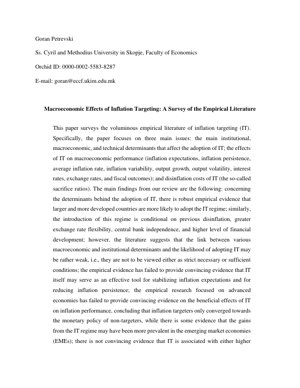
Inflation targeting (IT) emerged as a prominent monetary policy framework following New Zealand's adoption in 1990. The regime has since been implemented in 43 countries across both advanced and emerging market economies (EMEs). This paper surveys the extensive empirical literature examining IT's macroeconomic effects, focusing on adoption determinants, performance outcomes, and disinflation costs.
The global spread of IT represents what Rose (2007) describes as dominance in the international monetary system. Unlike previous monetary strategies, IT has demonstrated remarkable durability with no country abandoning the framework once adopted.
2. Determinants of IT Adoption
The empirical literature identifies several factors influencing countries' decisions to adopt inflation targeting regimes.
2.1 Institutional Factors
Robust evidence suggests that larger, more developed countries with greater central bank independence are more likely to adopt IT. The regime requires strong institutional commitment and transparent communication frameworks as outlined by Bernanke and Mishkin (1997).
2.2 Macroeconomic Conditions
Previous disinflation episodes and greater exchange rate flexibility typically precede IT adoption. However, the literature indicates these factors should not be viewed as strict necessary conditions.
2.3 Technical Requirements
Higher levels of financial development and reliable inflation forecasting capabilities are important technical prerequisites for successful IT implementation.
3. Macroeconomic Performance Under IT
3.1 Inflation Dynamics
Empirical evidence provides mixed results on IT's effectiveness in stabilizing inflation expectations and reducing inflation persistence. While some convergence toward lower inflation is observed, the causal role of IT itself remains debated.
3.2 Output Performance
The survey finds no convincing evidence that IT is associated with either higher output growth or lower output variability. This challenges early proponents' claims about IT's growth benefits.
3.3 Exchange Rate Effects
IT appears to have differential effects on exchange-rate volatility in advanced economies versus EMEs, though the mechanisms behind these differences require further investigation.
3.4 Fiscal Policy Interactions
Limited but supportive evidence suggests IT may improve fiscal discipline, though the causal channels remain underexplored in the literature.
4. Disinflation Costs and Sacrifice Ratios
The empirical support for IT being associated with lower disinflation costs (sacrifice ratios) appears weak. The relationship between IT adoption and the output costs of reducing inflation remains ambiguous in the surveyed literature.
5. Key Findings and Statistical Summary
Adoption Determinants
Strong evidence for institutional factors, weaker for macroeconomic conditions
Inflation Performance
Mixed evidence in advanced economies, more positive in EMEs
Growth Effects
No convincing evidence of positive impact
Fiscal Discipline
Limited but supportive evidence
6. Core Insight & Critical Analysis
Core Insight
The emperor has no clothes. After three decades and dozens of adoptions, the empirical literature delivers a sobering verdict: Inflation Targeting's macroeconomic benefits are, at best, modest and often indistinguishable from alternative frameworks. The survey reveals a striking gap between IT's theoretical promise and its empirical delivery, particularly in advanced economies where convergence rather than superiority characterizes outcomes.
Logical Flow
The narrative unfolds with predictable symmetry: early adoption by institutional pioneers (New Zealand, Canada, UK) creates a bandwagon effect, followed by methodological debates about measurement and causality, culminating in the current consensus of tempered expectations. The literature's evolution mirrors what we've seen in other policy domains—initial enthusiasm, methodological refinement, then empirical reality checks. What's particularly telling is how IT's perceived success in EMEs often stems from comparison with crisis-prone alternatives rather than inherent superiority.
Strengths & Flaws
Strengths: The framework's durability is undeniable—no defections speaks volumes about its political sustainability. The transparency benefits, while difficult to quantify, represent genuine institutional progress. The regime's flexibility in practice (as seen in Chile and Israel's phased implementations) demonstrates adaptive capacity missing from more rigid frameworks.
Flaws: The causality problem looms large—do IT countries perform better, or do better-performing countries choose IT? The survey's failure to establish clear growth benefits undermines the framework's economic rationale. Most damning is the evidence from advanced economies: if IT doesn't outperform alternatives where institutions are strongest, what's the value proposition? The framework's treatment of financial stability as a secondary concern looks increasingly problematic post-2008.
Actionable Insights
1. Demote IT from dogma to tool: Central banks should treat IT as one option among several, not as monetary policy's end state. The Bank of Japan's continued flexibility and the Fed's average inflation targeting represent healthier approaches.
2. Focus on what actually matters: The literature suggests institutional quality (central bank independence, transparency) matters more than the specific targeting regime. Resources should shift from regime maintenance to capacity building.
3. Rethink the emerging markets narrative: The apparent success in EMEs may reflect the absence of viable alternatives rather than IT's inherent virtues. Developing local currency bond markets and improving fiscal frameworks might yield higher returns.
4. Prepare for the next paradigm: With climate change and digital currencies reshaping the monetary landscape, clinging to 1990s frameworks is strategic malpractice. Research should pivot to integrated policy frameworks that address 21st century challenges.
The survey's most valuable contribution may be what it doesn't find: compelling evidence for IT's superiority. In an era demanding policy innovation, this should liberate rather than constrain central bankers. The framework served its purpose in taming high inflation, but its failure to deliver on broader economic objectives suggests we need new thinking, not more refinements of old approaches.
7. Technical Framework and Empirical Models
The empirical literature employs various econometric approaches to assess IT effects:
Difference-in-Differences Framework
A common approach compares outcomes before and after IT adoption relative to non-IT countries:
$Y_{it} = \alpha + \beta IT_{it} + \gamma X_{it} + \delta_i + \lambda_t + \epsilon_{it}$
Where $Y_{it}$ represents macroeconomic outcomes (inflation, growth), $IT_{it}$ is an indicator for IT adoption, $X_{it}$ are control variables, and $\delta_i$, $\lambda_t$ are country and time fixed effects.
Sacrifice Ratio Estimation
The output cost of disinflation is typically measured as:
$SR = \frac{\sum (\bar{Y} - Y_t)}{\Delta \pi}$
Where $\bar{Y}$ is potential output, $Y_t$ is actual output during disinflation, and $\Delta \pi$ is the reduction in inflation.
Propensity Score Matching
To address selection bias, studies often use matching methods to compare IT adopters with similar non-adopters:
$P(X_i) = Pr(IT_i = 1 | X_i)$
Where countries are matched based on observable characteristics $X_i$ before comparing outcomes.
8. Analysis Framework: Case Study Approach
Comparative Case Analysis: Chile vs. Mexico
Research Question: How do different implementation paths affect IT outcomes in emerging markets?
Methodological Framework:
- Case Selection: Chile (gradual implementation 1990-1999) vs. Mexico (accelerated implementation 1999-2002)
- Data Collection: Central bank communications, inflation reports, policy rate decisions (1990-2010)
- Analytical Dimensions:
- Inflation expectation anchoring (survey vs. market-based measures)
- Policy flexibility during external shocks
- Communication effectiveness (readability scores of inflation reports)
- Counterfactual Analysis: Construct synthetic control groups using non-IT Latin American countries
Expected Insights:
This approach would test whether gradual implementation (Chile) yields better institutional learning than rapid adoption (Mexico), and whether these differences persist in long-term outcomes.
9. Future Applications and Research Directions
Integration with Climate Objectives
Future IT frameworks may incorporate climate risk adjustments to policy rates or balance sheet operations, similar to proposals by the Network for Greening the Financial System (NGFS).
Digital Currency Implications
Central bank digital currencies (CBDCs) could transform IT implementation through improved monetary transmission and real-time economic data.
Machine Learning Enhancements
Advanced forecasting techniques using AI could address IT's reliance on imperfect inflation forecasts, potentially improving policy responsiveness.
Integrated Policy Frameworks
Moving beyond narrow inflation targets toward frameworks that explicitly balance price stability, financial stability, and employment objectives.
10. References
- Bernanke, B. S., & Mishkin, F. S. (1997). Inflation targeting: A new framework for monetary policy? Journal of Economic Perspectives, 11(2), 97-116.
- Hammond, G. (2012). State of the art of inflation targeting. Bank of England.
- IMF. (2020). Annual Report on Exchange Arrangements and Exchange Restrictions. International Monetary Fund.
- Mishkin, F. S. (2000). Inflation targeting in emerging market countries. American Economic Review, 90(2), 105-109.
- Mishkin, F. S., & Posen, A. S. (1997). Inflation targeting: Lessons from four countries. Economic Policy Review, 3(3).
- Rose, A. K. (2007). A stable international monetary system emerges: Inflation targeting is Bretton Woods, reversed. Journal of International Money and Finance, 26(5), 663-681.
- Svensson, L. E. (2002). Inflation targeting: Should it be modeled as an instrument rule or a targeting rule? European Economic Review, 46(4-5), 771-780.
- Svensson, L. E. (2010). Inflation targeting. In Handbook of Monetary Economics (Vol. 3, pp. 1237-1302). Elsevier.
- Walsh, C. E. (2009). Inflation targeting: What have we learned? International Finance, 12(2), 195-233.
- Petrevski, G. (2022). Macroeconomic Effects of Inflation Targeting: A Survey of the Empirical Literature. Ss. Cyril and Methodius University.