1. Introduction & Overview
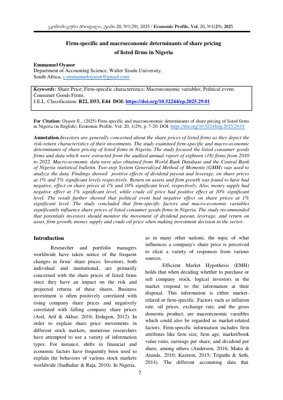
This study investigates the dual forces shaping share prices of listed consumer goods firms in Nigeria from 2010 to 2022. Grounded in the Efficient Market Hypothesis (EMH), it posits that investors rationally incorporate all available information—both firm-specific (micro) and market-wide (macro)—into their valuation decisions. The Nigerian equity market, like many emerging markets, is characterized by high volatility and sensitivity to external shocks, making the disentanglement of these drivers crucial for investors and policymakers alike.
The research fills a gap by simultaneously modeling internal financial metrics (e.g., profitability, leverage) and external economic/political factors (e.g., money supply, oil prices, political events) to provide a holistic view of share price determinants in a specific, vital sector of the Nigerian economy.
2. Research Methodology
A rigorous panel data approach was employed to ensure robust and reliable findings.
2.1 Data & Sample
The study focuses on 18 listed consumer goods firms on the Nigerian Exchange (NGX). Firm-specific financial data were extracted from audited annual reports spanning 2010–2022. Macroeconomic data were sourced from the World Bank's World Development Indicators and the Central Bank of Nigeria's statistical bulletin.
2.2 Empirical Model & Variables
The core dependent variable is the firm's Share Price (SP). The independent variables are categorized into:
- Firm-Specific: Dividend Payout Ratio (DPR), Leverage (LEV), Return on Assets (ROA), Firm Growth (GROWTH).
- Macroeconomic: Money Supply (M2), Crude Oil Price (OIL).
- Political: A dummy variable for significant political events (ELECT).
2.3 Estimation Technique: Two-Step System GMM
To address potential endogeneity (e.g., past share prices influencing current firm decisions) and unobserved firm heterogeneity, the study employs the Two-Step System Generalized Method of Moments (GMM) estimator developed by Arellano and Bover (1995) and Blundell and Bond (1998). This technique is superior to standard OLS or fixed-effects models in dynamic panel settings, using lagged levels and differences of variables as instruments.
3. Empirical Results & Findings
The System GMM estimation yielded statistically significant results, revealing a complex interplay of factors.
Positive Drivers
Dividend Payout: Positive effect (1% significance). Signals cash flow stability.
Leverage: Positive effect (5% significance). May signal growth ambitions.
Crude Oil Price: Positive effect (10% significance). Boosts national forex earnings.
Negative Drivers
Return on Assets (ROA): Negative effect (1% significance). Counter-intuitive; may indicate profit retention issues.
Firm Growth: Negative effect (10% significance). Suggures growth is perceived as risky or costly.
Money Supply (M2): Negative effect (1% significance). Indicates inflationary fears outweigh liquidity benefits.
Political Events: Negative effect (1% significance). Highlights market sensitivity to instability.
3.1 Firm-Specific Determinants
The positive impact of dividend payout aligns with traditional signaling theory, where dividends convey confidence in future earnings. The positive leverage effect is intriguing for an emerging market; it might reflect investor appetite for firms using debt for expansion in a growing economy, though it contrasts with pecking order theory. The negative coefficients for ROA and Growth are the most striking findings, contradicting standard finance theory and warranting deeper sector-specific investigation—perhaps high profitability is not being distributed, or growth is funded inefficiently.
3.2 Macroeconomic Determinants
The negative relationship between money supply and share prices is critical. It suggests that in the Nigerian context, expansions in M2 are primarily interpreted as precursors to inflation, which erodes real investment returns, rather than as stimulants for economic activity. The positive link with crude oil prices underscores the Nigerian market's fundamental dependency on hydrocarbon revenues for foreign exchange and government spending, which trickles down to consumer demand.
3.3 The Impact of Political Events
The significant negative impact of political event dummies quantifies a long-held belief: Nigerian equities are highly vulnerable to political uncertainty. Elections and related instability create a risk premium, driving down valuations as investors seek safer havens.
4. Discussion & Implications
The study concludes that share prices in Nigeria's consumer goods sector are not driven by a single narrative. They are a function of internal financial health signals (some counter-intuitive), the macro-fiscal environment, and the political climate. For investors, this means a myopic focus on bottom-line profitability (ROA) may be misleading. Monitoring dividend policies, debt levels, central bank actions, oil markets, and the political calendar is essential for a complete picture.
For policymakers, the negative reaction to money supply growth is a clear warning that managing inflation expectations is paramount for capital market development. The oil price dependency highlights the urgent need for economic diversification.
5. Technical Framework & Analysis
5.1 Core Econometric Model
The dynamic panel model is specified as follows:
$SP_{it} = \alpha + \beta_1 SP_{i,t-1} + \beta_2 DPR_{it} + \beta_3 LEV_{it} + \beta_4 ROA_{it} + \beta_5 GROWTH_{it} + \beta_6 M2_t + \beta_7 OIL_t + \beta_8 ELECT_t + \eta_i + \epsilon_{it}$
Where:
- $SP_{it}$: Share price of firm $i$ in year $t$.
- $SP_{i,t-1}$: Lagged share price (captures dynamic adjustment).
- $\eta_i$: Unobserved firm-specific fixed effects.
- $\epsilon_{it}$: Idiosyncratic error term.
The System GMM estimator uses moment conditions based on lagged levels and differences to instrument for the lagged dependent variable and other potentially endogenous regressors, ensuring consistent estimates.
5.2 Analysis Framework: A Practical Case
Scenario: An analyst in Q4 2024 is evaluating a Nigerian consumer goods firm, "NaijaFoods Plc."
Framework Application:
- Firm-Specific Check: Analyze NaijaFoods' recent reports. Is DPR stable/increasing? Is LEV rising due to a specific expansion plan? Is high ROA coupled with low dividend payout (explaining potential negative market view)?
- Macro Overlay: Check CBN data for M2 growth trends. Monitor Brent crude prices. High M2 growth + stable oil prices = conflicting signals (negative vs. positive).
- Political Risk Assessment: Is the country approaching an election cycle? If yes, apply a discount factor to valuation models to account for the quantified negative "political event" effect found in this study.
- Synthesis: The investment thesis should weight the positive signal from a strong DPR against the headwinds from aggressive M2 growth and upcoming political uncertainty. The negative correlation with ROA suggests not over-weighting profitability alone.
6. Future Research & Application Outlook
Research Directions:
- Extend the analysis to other sectors (banking, industrials) to test for sectoral heterogeneity.
- Incorporate more granular macroeconomic variables (e.g., sector-specific inflation, real interest rates).
- Use machine learning techniques (LASSO, Random Forests) to identify non-linear relationships and interaction effects among determinants, moving beyond the linear assumptions of GMM.
- Compare determinants across different emerging markets (e.g., Nigeria vs. Kenya vs. South Africa) to isolate country-specific institutional effects.
Application Outlook:
- FinTech & Investment Apps: The findings can be algorithmically integrated into robo-advisor platforms targeting African retail investors, providing automated risk scores based on real-time updates of the key variables (oil price, M2, political news sentiment).
- ESG Integration: Future models could integrate governance metrics (G from ESG) to further unpack the "political event" variable, distinguishing between election uncertainty and broader governance quality.
- Central Bank Communication: The strong market reaction to M2 suggests that the CBN's communication strategy around liquidity management is as important as the policy itself for market stability.
7. References
- Oyasor, E. (2025). Firm-specific and macroeconomic determinants of share pricing of listed firms in Nigeria. Economic Profile, 20(1), 7-20.
- Arellano, M., & Bover, O. (1995). Another look at the instrumental variable estimation of error-components models. Journal of Econometrics, 68(1), 29-51.
- Blundell, R., & Bond, S. (1998). Initial conditions and moment restrictions in dynamic panel data models. Journal of Econometrics, 87(1), 115-143.
- Fama, E. F. (1970). Efficient capital markets: A review of theory and empirical work. The Journal of Finance, 25(2), 383-417.
- World Bank. (2023). World Development Indicators. Retrieved from https://databank.worldbank.org
- Central Bank of Nigeria. (2023). Statistical Bulletin.
8. Analyst's Perspective: A Four-Step Critique
Core Insight: This paper delivers a crucial, data-driven reality check: the Nigerian equity market is a paradox. It rewards debt (leverage) and punishes accounting profitability (ROA), all while being held hostage by macro liquidity and political whims. The real story isn't about finding value in the traditional sense; it's about decoding a market where signals are often inverted and external noise dominates.
Logical Flow: The research design is robust—targeting a specific sector, using a long panel, and employing System GMM is the right methodological arsenal for this battle. The logic from hypothesis (EMH) to variable selection to model specification is coherent. However, the flow stumbles slightly in the discussion of the ROA finding. The paper notes the contradiction but doesn't aggressively enough pursue explanations—is it a sector-specific anomaly, a data issue, or a fundamental flaw in how Nigerian investors interpret earnings? This is the critical knot that needs untangling.
Strengths & Flaws:
Strengths: Quantifying the political risk premium is a major win. Moving from anecdote to a statistically significant coefficient is valuable. The use of System GMM correctly addresses endogeneity, a common flaw in simpler studies. Focusing on consumer goods, a non-financial sector, provides cleaner insights than aggregate market studies.
Flaws: The "political event" variable is binary and crude. A more nuanced index capturing election violence, policy uncertainty, or regulatory changes (like those from the IMF's research on policy uncertainty indices) would be more powerful. The negative ROA result is the elephant in the room—it either points to a revolutionary insight about market inefficiency or a potential model specification issue that requires robustness checks with alternative profitability measures (e.g., operating margin, EBITDA).
Actionable Insights:
- For Investors: Build a dashboard with four quadrants: Firm Payout Policy, Macro Watch (M2/Oil), Political Calendar, and Sector Sentiment. This study says to underweight the "Profitability" quadrant in your decision matrix for this market.
- For Company CFOs: Understand that taking on debt for visible growth may boost your share price more than squeezing out extra ROA through cost-cutting. Communication of strategy is key.
- For Regulators (CBN/NGX): The market's allergic reaction to M2 growth is a direct feedback loop. Prioritize inflation control and clear communication over aggressive monetary expansion if you seek to deepen capital markets. Foster research into developing a Nigerian VIX-like index that incorporates political risk.