1. Introduction

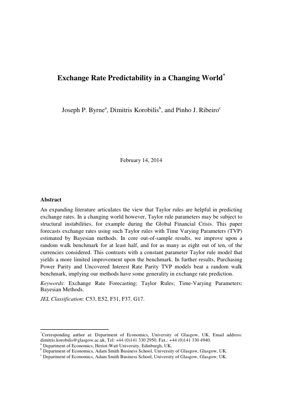
The quest to predict exchange rate movements, a cornerstone of international finance, has long been dominated by the shadow of the Meese-Rogoff (1983) puzzle, which posited the superiority of a naive random walk model over fundamentals-based approaches. This paper by Byrne, Korobilis, and Ribeiro (2014) directly confronts this challenge by introducing a critical innovation: acknowledging and modeling the time-varying nature of the economic relationships underpinning exchange rates. The authors argue that the failure of constant-parameter models stems from their inability to capture structural instabilities in monetary policy rules, particularly during turbulent periods like the Global Financial Crisis. Their proposed solution is a Bayesian Time-Varying Parameter (TVP) model applied to Taylor rule fundamentals, demonstrating significantly improved out-of-sample forecasting accuracy.

2. Theoretical Framework & Literature Review

This section establishes the intellectual foundation for the study, tracing the evolution from the Meese-Rogoff puzzle to more recent successes with Taylor rule models.

2.1 The Meese-Rogoff Puzzle

The seminal work of Meese and Rogoff (1983) showed that major structural models (monetary, portfolio balance) could not outperform a simple random walk in out-of-sample exchange rate forecasting, especially at short horizons. This result posed a significant challenge to the profession and spurred decades of research.

2.2 Taylor Rule Fundamentals

Engel and West (2005) and subsequent work reframed the problem through an asset pricing lens. Models where central banks follow Taylor-type rules—setting interest rates based on inflation and output gaps—can be cast in a present-value form. Engel et al. (2008) and Molodtsova and Papell (2009) provided empirical evidence that Taylor rule-based models could, in fact, beat the random walk, marking a breakthrough.

2.3 The Instability Challenge

However, predictability was often found to be ephemeral and sample-dependent. Rogoff and Stavrakeva (2008) and Rossi (2013) highlighted this instability, suggesting that the coefficients linking fundamentals to exchange rates are not fixed. This paper identifies this parameter instability as the key obstacle to robust forecasting.

3. Methodology: TVP-Bayesian Framework

The core methodological contribution is the application of a Bayesian Time-Varying Parameter model to exchange rate prediction.

3.1 Model Specification

The authors specify a forecasting equation where the exchange rate return (e.g., USD/EUR) is a function of Taylor rule fundamentals—the difference between domestic and foreign inflation and output gaps. Crucially, the coefficients ($\beta_t$) on these fundamentals are allowed to evolve over time as a random walk: $\beta_t = \beta_{t-1} + \eta_t$, where $\eta_t \sim N(0, Q)$. This captures gradual shifts in the market's pricing of these fundamentals.

3.2 Bayesian Estimation

Estimating such a model with frequentist methods is difficult due to the "curse of dimensionality." The authors employ Bayesian methods (likely a Gibbs sampler or similar Markov Chain Monte Carlo technique) to draw inferences on the entire path of time-varying parameters ($\{\beta_t\}_{t=1}^T$) and the hyperparameters (like the covariance matrix $Q$). Priors are used to impose sensible structure and manage parameter proliferation.

3.3 Forecasting Procedure

Out-of-sample forecasts are generated recursively. At each point in time, the model is estimated using data up to that point, the posterior distribution of parameters is obtained, and the predictive density for the future exchange rate is computed. This yields a distribution of forecasts, not just a point estimate.

4. Empirical Results & Analysis

Core Performance Snapshot

  • Benchmark: Random Walk (RW)
  • TVP-Taylor Model: Outperforms RW for 5 to 8 out of 10 currencies.
  • Constant-Parameter Taylor Model: Shows limited, less robust improvement.
  • Additional Success: TVP versions of Purchasing Power Parity (PPP) and Uncovered Interest Parity (UIP) also beat the RW.

4.1 Core Forecasting Performance

The headline result is compelling. The TVP-Taylor rule model delivers statistically significant out-of-sample forecasting gains against the random walk benchmark for a majority (at least half, up to eight) of the ten major exchange rates examined (likely including USD/EUR, USD/JPY, USD/GBP, etc.). This success rate is notably higher than what was typically achieved by earlier, static models.

4.2 Comparison with Constant Parameter Models

A key controlled experiment pits the TVP model against its constant-parameter counterpart. The latter shows only marginal or inconsistent improvement over the random walk, underscoring the critical value added by modeling parameter instability. This directly addresses the sample-dependency critique of earlier literature.

4.3 Robustness: PPP & UIP Models

To demonstrate the generality of their methodological approach, the authors apply the same TVP-Bayesian framework to two other classic fundamental models: Purchasing Power Parity and Uncovered Interest Rate Parity. The finding that these TVP-augmented models also beat the random walk is powerful evidence that the method—handling time-variation—is as important as the specific theory (Taylor rules).

5. Technical Details & Mathematical Formulation

The core TVP forecasting model can be represented as a state-space system:

Observation Equation:
$\Delta s_{t+1} = x_t' \beta_t + \epsilon_{t+1}, \quad \epsilon_{t+1} \sim N(0, \sigma^2_\epsilon)$
Where $\Delta s_{t+1}$ is the exchange rate return, $x_t$ contains Taylor rule differentials (inflation gap, output gap), and $\beta_t$ is the time-varying coefficient vector.

State Equation:
$\beta_t = \beta_{t-1} + \eta_t, \quad \eta_t \sim N(0, Q)$
This random walk evolution for $\beta_t$ captures persistent shifts. The Bayesian estimation involves specifying priors for $\beta_0$, $\sigma^2_\epsilon$, and $Q$, and then using MCMC to sample from the joint posterior $p(\{\beta_t\}, \sigma^2_\epsilon, Q | Data)$.

6. Analytical Framework & Case Example

Case: Forecasting USD/EUR during the 2008-2012 Period.

  1. Pre-Crisis (Pre-2008): A constant-parameter model might estimate a stable relationship where a positive US inflation gap (relative to the Eurozone) predicts USD depreciation. The TVP model would likely find a stable $\beta_t$ in this period.
  2. Financial Crisis (2008-2009): Market dynamics break down. "Flight to safety" dominates, making traditional fundamentals poor predictors. The TVP model's $\beta_t$ for the inflation gap would likely shift dramatically, perhaps even changing sign, as the model adapts to the new regime where liquidity and risk aversion trump standard policy rules.
  3. Post-Crisis & Eurozone Debt Crisis (2010-2012): Diverging central bank policies (Fed's QE vs. ECB's initial hesitation) create new drivers. The TVP model's coefficients would evolve again to reflect the changing impact of policy differentials on the exchange rate, potentially capturing the effect of unconventional policy tools not in the standard Taylor rule.

This example illustrates how the TVP framework acts as a self-correcting mechanism, allowing the predictive relationship to adapt through time, unlike a static model which would be persistently wrong during structural breaks.

7. Future Applications & Research Directions

  • Integration with Machine Learning: Combining the Bayesian TVP structure with flexible machine learning estimators (e.g., Bayesian Neural Networks with time-varying weights) to capture non-linearities alongside parameter drift.
  • High-Frequency Forecasting: Applying the framework to intraday or daily data, where regime shifts can be even more abrupt, for algorithmic trading applications.
  • Global Factor TVP Models: Extending the model to include latent global risk factors (like the VIX, commodity indices) with time-varying loadings, as suggested by the factor model literature (e.g., Engel et al., 2012).
  • Central Bank Communication: Incorporating text-derived measures of monetary policy stance (from speeches, reports) as time-varying predictors, moving beyond simple output and inflation gaps.
  • Portfolio Management Tools: Developing practical tools for currency hedge fund managers and international portfolio managers based on TVP-based signals for dynamic hedging ratios.

8. References

  • Byrne, J. P., Korobilis, D., & Ribeiro, P. J. (2014). Exchange Rate Predictability in a Changing World. Unpublished Manuscript.
  • Engel, C., & West, K. D. (2005). Exchange Rates and Fundamentals. Journal of Political Economy.
  • Engel, C., Mark, N. C., & West, K. D. (2008). Exchange Rate Models Are Not As Bad As You Think. NBER Macroeconomics Annual.
  • Meese, R. A., & Rogoff, K. (1983). Empirical Exchange Rate Models of the Seventies: Do They Fit Out of Sample? Journal of International Economics.
  • Molodtsova, T., & Papell, D. H. (2009). Out-of-Sample Exchange Rate Predictability with Taylor Rule Fundamentals. Journal of International Economics.
  • Rossi, B. (2013). Exchange Rate Predictability. Journal of Economic Literature.
  • Taylor, J. B. (1993). Discretion versus policy rules in practice. Carnegie-Rochester Conference Series on Public Policy.

9. Analyst's Perspective: Core Insight & Critique

Core Insight

Byrne et al. have successfully shifted the paradigm. The problem isn't that fundamentals don't matter for exchange rates; it's that how much they matter changes over time. Their TVP-Bayesian framework isn't just another incremental model tweak—it's a fundamental acknowledgment that financial markets are adaptive systems, not static laboratories. The true breakthrough is methodological: applying tools from Bayesian econometrics (well-known in macroeconomics for handling parameter instability, as in Cogley & Sargent, 2005) to the thorny problem of FX prediction.

Logical Flow

The argument is elegant and well-structured: (1) Establish the historical puzzle (Meese-Rogoff). (2) Highlight a promising theoretical solution (Taylor rules). (3) Identify its fatal flaw in practice (parameter instability). (4) Propose a technically sound remedy (TVP-Bayesian). (5) Validate it empirically with clear, comparative results. The flow from problem diagnosis to technical solution to empirical validation is compelling.

Strengths & Flaws

Strengths: The paper's greatest strength is its empirical success where so many have failed. Beating the random walk for 5-8 out of 10 currencies is a result that commands attention. The robustness check using PPP and UIP is a masterstroke, proving the method's generality. Technically, the Bayesian approach is state-of-the-art for this problem.

Flaws & Gaps: The analysis, however, feels like a brilliant proof-of-concept rather than a finished product. Key practical details are glossed over: the exact specification of the Taylor rule fundamentals, the choice of priors (which can heavily influence Bayesian results), and the computational burden. More critically, while it detects instability, it doesn't explain it. What economic events trigger the shifts in $\beta_t$? Linking parameter changes to specific policy regimes or volatility episodes would add immense explanatory power. Furthermore, the comparison to more modern machine learning benchmarks (like random forests or LSTMs that can also handle non-linearities and structural breaks) is absent—a necessary test for any new forecasting model today.

Actionable Insights

For Researchers: This paper is a blueprint. The immediate next step is to open the "black box" of time-variation. Use the estimated $\beta_t$ paths as dependent variables to model what drives the instability (e.g., using volatility indices or policy uncertainty measures). For Quantitative Fund Managers: The core idea is implementable. Start by incorporating simple rolling-window or regime-switching models as a robustness check for your existing FX signals. The TVP concept warns against over-relying on relationships estimated over long, calm historical periods. For Policy Analysts: The findings underscore that the transmission mechanism of monetary policy to exchange rates is non-constant. This should temper overconfidence in policy simulations based on fixed-coefficient international models.

In conclusion, this paper doesn't fully solve the exchange rate prediction puzzle, but it correctly identifies and attacks its central piece: instability. It provides a powerful, flexible framework that is likely to become a standard benchmark in the field, pushing future work towards more adaptive, realistic models of financial markets.