Table of Contents
1. Introduction
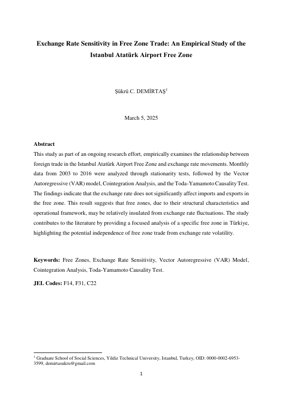
This study empirically investigates the relationship between foreign trade activities within the Istanbul Atatürk Airport Free Zone and fluctuations in exchange rates. Free zones, established to circumvent trade restrictions and boost foreign exchange earnings, are theoretically exposed to currency volatility. This research aims to test this assumption using advanced econometric techniques on monthly data spanning 2003-2016.
2. Literature Review & Theoretical Framework
Free zones are defined as areas within a country's borders but outside its customs territory, designed to promote export-oriented production and foreign investment. The literature suggests mixed impacts: positive effects on employment and forex accumulation versus potential negatives like tax revenue loss and smuggling. The core theoretical question is whether the unique operational framework of free zones—characterized by tax exemptions, duty-free imports, and streamlined procedures—insulates their trade flows from macroeconomic variables like exchange rates.
3. Methodology & Data
The study employs a rigorous time-series econometric approach to analyze the sensitivity of free zone trade to exchange rate movements.
3.1. Data Description
Analysis is based on monthly time-series data from 2003 to 2016. Key variables include:
- Free Zone Exports (FZ_EX)
- Free Zone Imports (FZ_IM)
- Nominal Exchange Rate (EXR) – likely TRY/USD.
3.2. Econometric Models
The methodological pipeline consists of:
- Stationarity Tests: Augmented Dickey-Fuller (ADF) and Phillips-Perron (PP) tests to determine the order of integration of the variables.
- Vector Autoregressive (VAR) Model: To capture the linear interdependencies among multiple time series.
- Cointegration Analysis (Johansen Test): To test for long-run equilibrium relationships among non-stationary variables.
- Toda-Yamamoto Causality Test: A modified Granger causality test applicable regardless of cointegration or stationarity properties.
4. Empirical Results & Analysis
4.1. Stationarity Tests
The results indicated that the variables (FZ_EX, FZ_IM, EXR) were non-stationary at level but became stationary after first differencing, i.e., they are I(1) processes. This finding justifies the subsequent use of cointegration analysis.
4.2. VAR Model & Cointegration
The estimated VAR model showed weak short-term dynamic relationships between exchange rates and free zone trade volumes. Crucially, the Johansen cointegration test failed to find a statistically significant long-run relationship between the exchange rate and either imports or exports within the free zone.
4.3. Toda-Yamamoto Causality Test
The Toda-Yamamoto procedure confirmed the core finding: no statistically significant Granger-causal relationship was found running from exchange rate movements to free zone imports or exports. This robustly supports the hypothesis of exchange rate insensitivity.
5. Discussion & Implications
The null results are significant. They suggest that the structural characteristics of the Istanbul Atatürk Airport Free Zone—such as duty-free intermediate inputs, long-term contracts denominated in stable currencies, and a focus on re-export—create a buffer against exchange rate volatility. This implies that policy measures targeting the general economy through currency adjustments may have limited direct impact on free zone performance.
6. Conclusion
This study concludes that trade flows in the Istanbul Atatürk Airport Free Zone are not significantly affected by exchange rate movements during the 2003-2016 period. The findings highlight the potential for free zones to act as stabilizers in an economy prone to currency fluctuations, offering a predictable environment for export-oriented investment. The research contributes a focused, empirical case study from Türkiye to the international literature on free zone economics.
7. Original Analysis & Expert Commentary
Core Insight: Demirtaş delivers a counterintuitive but empirically robust punchline: a major macroeconomic lever—the exchange rate—is effectively neutered within the specific microcosm of a Turkish free zone. This isn't just a statistical quirk; it's evidence of a successfully engineered economic enclave that decouples operational trade from national currency volatility.
Logical Flow: The study's strength lies in its methodological rigor. It doesn't just run a simple correlation. The progression from unit root tests (establishing I(1) processes) to cointegration analysis (searching for long-run ties) and finally to the Toda-Yamamoto causality test (a robust check for influence) creates a formidable chain of evidence. The consistent "null result" across different tests makes the conclusion of insensitivity far more credible than a single negative correlation would.
Strengths & Flaws: The primary strength is its focused, clean empirical design on a unique dataset. However, the analysis has blind spots. First, it treats the free zone as a black box. Why is it insensitive? Is it due to currency hedging by firms, the use of USD-denominated contracts (a common practice in global trade as noted in IMF working papers), or the nature of goods traded (high-value, low-elasticity products)? Second, the period (2003-2016) includes relative stability in Turkish free zone policy. Would this insensitivity hold during a period of hyperinflation or drastic policy shift? Studies on Jebel Ali Free Zone (UAE) suggest resilience, but context matters.
Actionable Insights: For policymakers, this study is a double-edged sword. The good news: free zones can be reliable forex earners even during currency turmoil. The bad news: manipulating the exchange rate as a tool to directly boost free zone activity is futile. The real lever is improving the zone's structural advantages—logistics, regulatory simplicity, and connectivity—factors this study hints at but doesn't measure. For investors, the message is clear: the Istanbul Atatürk Airport Free Zone offered a hedge against currency risk. The critical question for future capital allocation is whether this structural decoupling remains intact under Türkiye's current economic paradigm.
8. Technical Details & Mathematical Framework
The core econometric models are specified below:
Vector Autoregressive (VAR) Model of order p:
$Y_t = c + A_1Y_{t-1} + A_2Y_{t-2} + ... + A_pY_{t-p} + \epsilon_t$
where $Y_t = [\text{FZ_EX}_t, \text{FZ_IM}_t, \text{EXR}_t]'$ is a vector of endogenous variables, $c$ is a vector of constants, $A_i$ are coefficient matrices, and $\epsilon_t$ is a vector of white noise error terms.
Johansen Cointegration Test is based on the estimation of:
$\Delta Y_t = \Pi Y_{t-1} + \sum_{i=1}^{p-1} \Gamma_i \Delta Y_{t-i} + \epsilon_t$
where $\Pi = \alpha \beta'$. The test examines the rank ($r$) of the $\Pi$ matrix. A rank of zero indicates no cointegration.
Toda-Yamamoto Causality Test: An augmented VAR($p+d_{max}$) model is estimated, where $d_{max}$ is the maximum order of integration. Causality from variable $j$ to variable $i$ is tested by restricting the first $p$ lags of variable $j$ in the equation for variable $i$ to be zero, using a standard Wald test.
9. Analysis Framework: A Conceptual Case Study
Scenario: A multinational electronics firm, "GlobalTech," operates within the Istanbul Atatürk Airport Free Zone. It imports high-value semiconductor components duty-free, assembles them into finished devices, and exports 95% of its output to the EU.
Framework Application:
- Cost Structure Isolation: GlobalTech's major input costs (semiconductors) are invoiced in USD and imported duty-free. A depreciation of the Turkish Lira (TRY) does not increase its landed cost in USD terms.
- Revenue Currency: Sales contracts with EU buyers are denominated in Euros (EUR). TRY volatility does not affect the EUR-denominated revenue stream.
- Financial Hedging: The firm uses forward contracts to lock in the EUR/TRY exchange rate for converting profits, further insulating its bottom line from spot rate fluctuations.
- Empirical Prediction: Following the study's framework, GlobalTech's import and export volumes (in physical units or stable currency value) should show no statistically significant response to TRY/USD or TRY/EUR movements. Its trade decisions are driven by global demand and supply chain logistics, not short-term exchange rate moves.
This case illustrates the micro-foundations behind the aggregate empirical result of exchange rate insensitivity.
10. Future Applications & Research Directions
- Cross-Zone Comparative Analysis: Replicate this methodology for other Turkish free zones (e.g., Mersin, İzmir) and international counterparts (e.g., Jebel Ali, Dubai; Shannon, Ireland) to identify common insulating factors and zone-specific vulnerabilities.
- Microdata Integration: Augment macro time-series analysis with firm-level survey data to unpack the causal mechanisms—hedging practices, contract currencies, inventory management—that drive the aggregate insensitivity.
- Extended Variable Set: Incorporate global demand indicators (e.g., World Trade Volume Index), commodity prices, and domestic political risk indices into the VAR model to see if free zone trade is more sensitive to these factors than to exchange rates.
- Policy Shock Analysis: Use an event-study methodology or a Structural VAR (SVAR) to analyze the impact of specific changes in free zone regulation or national trade policy, rather than continuous exchange rate moves.
- Real vs. Nominal Effects: Investigate whether real effective exchange rates (REER), which account for inflation differentials, have any impact, as they better reflect competitiveness.
11. References
- Demirtaş, Ş. C. (2025). Exchange Rate Sensitivity in Free Zone Trade: An Empirical Study of the Istanbul Atatürk Airport Free Zone.
- Bağrıaçık, M. (1983). Serbest Bölgeler. İstanbul: İTO Yayınları.
- İstanbul Ticaret Odası (ITO). (1960). Serbest Bölgeler Hakkında Rapor. Ankara: Ticaret Bakanlığı.
- Toda, H. Y., & Yamamoto, T. (1995). Statistical inference in vector autoregressions with possibly integrated processes. Journal of Econometrics, 66(1-2), 225–250.
- Johansen, S. (1991). Estimation and Hypothesis Testing of Cointegration Vectors in Gaussian Vector Autoregressive Models. Econometrica, 59(6), 1551–1580.
- International Monetary Fund. (2023). Annual Report on Exchange Arrangements and Exchange Restrictions. Washington, DC: IMF.
- World Bank. (2022). Special Economic Zones: An Operational Review of Their Impacts. World Bank Group.