Table of Contents
1. Introduction & Conference Overview
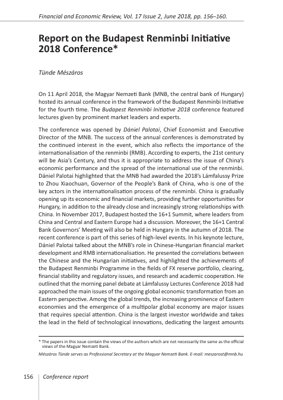
The 2018 Budapest Renminbi Initiative Conference, hosted by the Magyar Nemzeti Bank (MNB), marked the fourth annual gathering focused on the internationalization of the Chinese Renminbi (RMB). The event convened prominent market leaders and experts to discuss China's economic ascent and its implications for global finance, with a specific focus on Central and Eastern Europe (CEE). The conference underscored Hungary's proactive role in fostering financial ties with China, positioning itself as a bridgehead within the European Union for China's Belt and Road Initiative (BRI).
2. Key Themes & Discussions
2.1 The Rise of Asia and RMB Internationalization
The conference framed the 21st century as "Asia's Century," with China's economic performance and the international spread of the RMB at its core. Keynote speaker Dániel Palotai highlighted the MNB's alignment with China's financial integration goals under the BRI, noting the central bank's early engagement on the "New Silk Road." The awarding of the Lámfalussy Prize to Zhou Xiaochuan, former Governor of the People's Bank of China, symbolized recognition of his pivotal role in RMB internationalization.
2.2 Hungary's Strategic Positioning
Hungary's multifaceted engagement with China was detailed:
- Membership & Investment: Member of the Asian Infrastructure Investment Bank (AIIB) since 2017; investor in the SINO-CEE Fund via Eximbank.
- Infrastructure: Signatory to the Budapest-Belgrade railway construction agreement (2015).
- Capital Markets: Successful issuance of "panda" (onshore) and "dim sum" (offshore) bonds in Chinese markets.
- High-Level Diplomacy: Host of the 16+1 Summit (2017) and the upcoming 16+1 Central Bank Governors' Meeting.
2.3 Market Access and Financial Integration
Florence Lee of HSBC detailed China's capital market liberalization, including the Renminbi Qualified Foreign Institutional Investor (RQFII) scheme. A critical point was raised: while Hungary held an RQFII quota comparable to nations like Australia and Switzerland, it was among five countries that had not yet utilized its quota for onshore securities investment, indicating a potential gap between strategic positioning and practical financial market engagement.
Key Data Point
RQFII Quota Utilization (as of end-2017): Hungary was 1 of 18 countries with an allocated quota but 1 of 5 that had not yet used it for onshore investments.
3. Core Insights & Analyst Perspective
Core Insight: The Budapest conference was less a technical symposium and more a strategic signaling event. Hungary is executing a calculated, state-driven "bridge and hub" strategy within the EU, leveraging China's BRI to attract capital and elevate its geopolitical relevance. This is a top-down, institutional play, not an organic market-driven process.
Logical Flow: The narrative progresses from the macro ("Asia's Century") to the specific (Hungary's role). It connects China's global financial ambitions (RMB internationalization, BRI) with Hungary's national development goals (infrastructure funding, FDI). The MNB acts as the key orchestrator, using monetary diplomacy (RQFII, panda bonds) to facilitate this convergence.
Strengths & Flaws: Strengths: The strategy is coherent and proactive. Hungary has secured first-mover advantages in CEE regarding Chinese engagement. The multi-track approach—combining diplomacy (16+1), policy (MNB initiatives), and finance (AIIB, bonds)—is sophisticated. Flaws: The report reveals a critical weakness: the utilization gap. Having an RQFII quota but not using it suggests Hungarian institutional investors may lack the appetite, expertise, or mandate to deploy capital in China's complex onshore markets. This creates a dissonance between political signaling and financial reality. Furthermore, the strategy carries significant dependency risks and potential geopolitical friction within the EU.
Actionable Insights: For Hungary: Move beyond quota acquisition to quota activation. Develop dedicated China-focused investment vehicles and expertise within domestic financial institutions. For other CEE nations: Analyze Hungary's model not just for emulation, but for identifying gaps (like the utilization issue) to exploit. For EU policymakers: Monitor these bilateral financial corridors closely, as they could challenge the bloc's unified stance on China and create regulatory arbitrage opportunities.
4. Technical Framework & Analytical Models
Analyzing the success of such bilateral financial integration can be modeled using a modified Gravity Model of trade, applied to capital flows. The potential financial flow ($F_{ij}$) between country $i$ (e.g., Hungary) and country $j$ (e.g., China) can be expressed as:
$F_{ij} = G \frac{M_i^\alpha M_j^\beta}{D_{ij}^\gamma} \cdot P_{ij}^\delta$
Where:
- $G$ is a constant.
- $M_i, M_j$ are the economic masses (e.g., GDP) of the two countries.
- $D_{ij}$ represents the "distance," which in this context includes not just geography but also institutional, regulatory, and informational barriers.
- $P_{ij}$ is a policy variable (0 to 1) critical to this case. It captures the effect of specific bilateral agreements like the RQFII quota, BRI participation, and currency swap lines. $P_{ij}$ aims to reduce the effective $D_{ij}$.
- $\alpha, \beta, \gamma, \delta$ are elasticities.
Analysis Framework Example: The RQFII Utilization Decision Tree
A Hungarian asset manager's decision to use the RQFII quota can be framed as a case analysis:
- Problem: Underutilization of allocated RQFII quota.
- Root Cause Analysis:
- Capability Gap: Lack of in-house expertise on Chinese A-shares/bond markets.
- Risk-Reward Assessment: Perceived volatility and regulatory opacity of onshore markets outweigh potential returns.
- Strategic Misalignment: Investment mandate may not include or prioritize Chinese assets.
- Operational Hurdles: Complexity of setting up custody, settlement, and forex channels for RMB.
- Solution Pathways:
- Partner with an experienced global or Asian asset manager via a sub-advisory or fund-of-funds model.
- Invest initially in passive instruments (e.g., CSI 300 ETF) to gain exposure with lower active management risk.
- Lobby for a "pooled" national investment vehicle sponsored by the MNB or Eximbank to achieve scale and share expertise.
5. Future Applications & Strategic Directions
The trajectory outlined suggests several future developments:
- From Quotas to Flows: The next phase must focus on activating financial instruments. Expect increased issuance of RMB-denominated bonds ("Panda Bonds") by Hungarian state-owned enterprises and potentially a dedicated Hungary-China investment fund.
- Digital Currency Integration: With China's lead in Central Bank Digital Currency (CBDC) via the Digital Currency Electronic Payment (DCEP) system, future cooperation could involve pilot projects for cross-border CBDC settlements between the MNB and PBOC, reducing reliance on traditional SWIFT channels. Research from the Bank for International Settlements (BIS) on multi-CBDC arrangements (mBridge project) provides a relevant framework.
- Green Finance Nexus: Aligning with both EU Green Deal and China's green finance ambitions. Hungary could position itself as a hub for issuing "Green Panda Bonds" to finance sustainable infrastructure projects linked to the BRI in the CEE region.
- Risk Mitigation Frameworks: Developing co-investment and risk-sharing models with Chinese policy banks to address the debt sustainability concerns often associated with BRI projects.
6. References
- Magyar Nemzeti Bank. (2018). Report on the Budapest Renminbi Initiative 2018 Conference. Financial and Economic Review, 17(2), 156–160.
- People's Bank of China. (2015). RMB Internationalization Report. Beijing.
- European Central Bank. (2021). The international role of the euro. Frankfurt.
- Bank for International Settlements Innovation Hub. (2022). Project mBridge: Connecting economies through CBDC. Basel.
- World Bank. (2019). Belt and Road Economics: Opportunities and Risks of Transport Corridors. Washington, DC.
- Szunomár, Á. (2020). Chinese Investments in Central and Eastern Europe: The Case of Hungary. Institute of World Economics, Centre for Economic and Regional Studies.