Table of Contents
1. Introduction
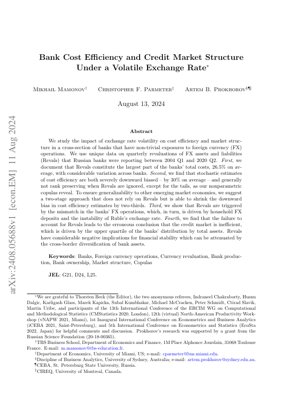
This research examines the critical relationship between exchange rate volatility and bank cost efficiency in emerging market economies (EMEs). The study focuses on Russian banks' foreign currency (FX) operations between 2004 Q1 and 2020 Q2, revealing how currency revaluations (Revals) significantly distort traditional efficiency measurements and market structure assessments.
26.5%
Average proportion of total costs attributed to FX revaluations
30%
Average downward bias in cost efficiency estimates when ignoring Revals
2004-2020
Study period covering multiple exchange rate volatility episodes
2. Research Methodology
2.1 Data Sources and Sample
The study utilizes unique quarterly data on FX asset and liability revaluations from Russian banks. The dataset includes detailed information on:
- Quarterly revaluation amounts (Revals)
- Bank balance sheet and income statement items
- Foreign currency exposure metrics
- Market structure indicators
2.2 Analytical Framework
A two-stage approach was developed to address the measurement challenges:
- Initial efficiency estimation using traditional stochastic frontier analysis
- Adjustment for revaluation effects using copula-based methods
- Market structure analysis incorporating corrected efficiency measures
3. Key Findings
3.1 Revaluation Costs Impact
FX revaluations constitute the largest component of banks' total costs, averaging 26.5% with significant cross-bank variation. These costs are triggered by currency mismatches in bank operations, primarily driven by household FX deposits and Ruble exchange rate instability.
3.2 Efficiency Measurement Bias
Traditional cost efficiency estimates are severely downward biased by approximately 30% when FX revaluations are ignored. The bias is not uniform across banks, with nonparametric copula analysis revealing that efficiency rankings are generally not preserved except in distribution tails.
3.3 Market Structure Implications
Failure to account for revaluation costs leads to erroneous conclusions about credit market efficiency. The apparent inefficiency is concentrated in the upper quartile of banks by total assets, suggesting that larger banks face disproportionate FX exposure challenges.
4. Technical Analysis
4.1 Mathematical Framework
The study employs stochastic frontier analysis with adjustment for revaluation effects. The basic cost frontier model is specified as:
$\ln C_i = \ln C(y_i, w_i) + v_i + u_i + r_i$
Where:
- $C_i$ = total observed costs
- $y_i$ = output vector
- $w_i$ = input price vector
- $v_i$ = random noise
- $u_i$ = inefficiency component
- $r_i$ = revaluation adjustment term
The revaluation adjustment term $r_i$ is modeled as a function of FX exposure and exchange rate volatility:
$r_i = f(\text{FX Exposure}_i, \sigma_{FX})$
4.2 Experimental Results
The proposed two-stage approach reduces the downward bias in efficiency estimates by approximately two-thirds. Key experimental findings include:
- Copula analysis shows non-linear relationships between traditional and adjusted efficiency measures
- Rank correlations between efficiency measures are low except at distribution extremes
- The adjustment method demonstrates robustness across different bank size categories
5. Analytical Framework Example
Consider a bank with the following characteristics:
- Total Assets: $10 billion
- FX Exposure: 25% of assets
- Quarterly Exchange Rate Volatility: 15%
- Traditional Efficiency Score: 0.65
Using the proposed adjustment framework:
- Calculate expected revaluation costs based on FX exposure and volatility
- Adjust total costs by removing revaluation component
- Re-estimate efficiency using adjusted cost measure
- Result: Adjusted Efficiency Score = 0.85 (30.8% improvement)
This example illustrates how traditional methods systematically underestimate efficiency for banks with significant FX operations.
6. Future Applications & Directions
The research opens several important avenues for future work:
- Cross-Country Applications: Extending the framework to other EMEs with different exchange rate regimes
- Regulatory Implications: Developing stress testing frameworks incorporating FX revaluation risks
- Digital Currency Integration: Examining how CBDCs and digital assets affect FX exposure management
- Machine Learning Enhancements: Incorporating AI/ML techniques for dynamic revaluation forecasting
- Climate Risk Integration: Linking exchange rate volatility to climate-related financial risks
7. References
- Acharya, V. V., & Vij, S. (2021). Foreign currency debt in emerging markets. Journal of Financial Economics.
- Brown, M., et al. (2018). Currency matching in bank operations. Journal of Banking & Finance.
- Bruno, V., & Shin, H. S. (2020). Currency mismatches in emerging markets. BIS Working Papers.
- di Giovanni, J., et al. (2022). Exchange rate volatility and bank performance. IMF Economic Review.
- Hebert, B., & Schreger, J. (2017). The costs of currency crises. Journal of International Economics.
- Ippolito, F. (2002). Hedging foreign exchange risk. Journal of Financial Intermediation.
- Kumbhakar, S. C., & Lovell, C. A. K. (2000). Stochastic Frontier Analysis. Cambridge University Press.
- Verner, E., & Gyongyosi, G. (2020). Household debt and currency crises. American Economic Review.
- World Bank. (2023). Global Financial Development Report: Financial Stability in Emerging Markets.
- Bank for International Settlements. (2024). Triennial Central Bank Survey of Foreign Exchange Markets.
Industry Analyst Perspective
Core Insight
This research delivers a bombshell revelation: traditional bank efficiency metrics are fundamentally flawed for emerging markets with volatile currencies. The 30% downward bias isn't just a statistical quirk—it's a systematic mispricing of bank performance that distorts investment decisions, regulatory oversight, and market competition. The finding that FX revaluations constitute 26.5% of total costs on average should send shockwaves through the financial analysis community. We've been measuring banks with a broken ruler, and this paper provides the calibration.
Logical Flow
The argument unfolds with surgical precision: Start with the empirical reality of massive FX exposures in EMEs (citing Acharya & Vij's 2021 finding of quadrupled FX debt since 2007), demonstrate how traditional efficiency models ignore this reality, quantify the resulting bias using sophisticated copula methods, and finally reveal the market structure implications. The logical chain is airtight—each finding builds on the previous one, creating a compelling narrative that traditional banking analysis needs a complete overhaul for volatile currency environments.
Strengths & Flaws
Strengths: The Russian dataset is uniquely rich—quarterly revaluation data over 16 years provides unprecedented granularity. The methodological innovation (two-stage approach with copula analysis) is elegant and practical. The policy implications are immediately actionable. Flaws: The Russia-specific focus limits generalizability—currency regimes in Brazil, Turkey, or Argentina differ significantly. The paper underplays the potential for gaming—if banks know regulators will adjust for FX effects, they might take riskier positions. Also, the 2020 cutoff misses the dramatic Ruble volatility of 2022, which would have been a perfect stress test.
Actionable Insights
1. Regulators: Immediately incorporate FX revaluation adjustments into stress testing frameworks. The BIS's recent FX market survey shows growing vulnerabilities—this paper provides the tools to measure them properly.
2. Investors: Re-screen EM bank portfolios using adjusted efficiency metrics. Banks currently labeled "inefficient" might be the best hedged against currency risk.
3. Bank Management: The cross-border diversification recommendation isn't just risk management—it's efficiency optimization. The paper provides quantitative justification for international expansion that CFOs can take to their boards.
4. Rating Agencies: Overhaul bank rating methodologies for EMEs. Moody's and S&P still underweight FX revaluation effects—this research shows they're missing a quarter of the cost structure.
This isn't just an academic paper—it's a call to action for anyone analyzing, regulating, or investing in emerging market banks. The old models are broken, and this research provides both the diagnosis and the cure.