Table of Contents
- 1. Introduction
- 2. Core Insight
- 3. Logical Flow
- 4. Strengths & Flaws
- 5. Actionable Insights
- 6. Technical Details and Mathematical Framework
- 7. Experimental Results and Chart Descriptions
- 8. Analytical Framework Example
- 9. Original Analysis and Comparative Insights
- 10. Future Applications and Directions
- 11. References
1. Introduction
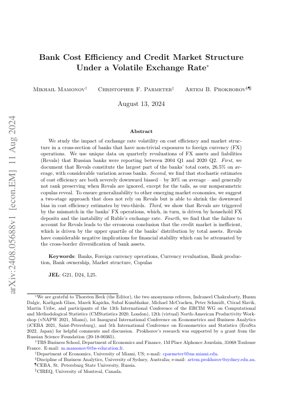
This paper investigates the impact of exchange rate volatility on bank cost efficiency and credit market structure, focusing on banks with significant foreign currency (FX) exposures. Using unique quarterly data on FX asset and liability revaluations (Revals) from Russian banks between 2004 Q1 and 2020 Q2, the authors demonstrate that Revals constitute a substantial portion of bank costs (26.5% on average) and that ignoring them leads to severely biased cost efficiency estimates. The study also explores the implications for credit market efficiency and financial stability.
2. Core Insight
Core Insight: Exchange rate volatility creates a hidden cost channel through currency revaluations that, if ignored, dramatically distorts bank cost efficiency measurement and leads to erroneous conclusions about credit market structure. The paper reveals that standard stochastic frontier models underestimate bank efficiency by up to 30% when Revals are omitted, and that this bias is not uniform across banks, affecting rank preservation and policy inference.
3. Logical Flow
3.1 Data and Methodology
The authors use a panel dataset of Russian banks from 2004-2020, including unique data on FX revaluations. They employ a stochastic frontier analysis (SFA) framework to estimate cost efficiency, comparing models with and without Revals. Nonparametric copulas are used to examine rank preservation and tail dependencies.
3.2 Key Findings
- Revals account for 26.5% of total bank costs on average, with high cross-bank variation.
- Ignoring Revals causes a 30% downward bias in cost efficiency estimates.
- Rank preservation is generally poor except at the tails of the efficiency distribution.
- A two-stage approach using observable bank characteristics can reduce the bias by two-thirds.
- Revals are driven by household FX deposits and Ruble instability.
- Failure to account for Revals leads to the false conclusion that the credit market is inefficient, driven by large banks.
4. Strengths & Flaws
Strengths: The paper uses a novel, high-quality dataset (Revals) that directly captures FX revaluation costs. The methodological contribution—using copulas to analyze rank preservation—is innovative and provides deeper insights into the nature of the bias. The two-stage correction approach is practical and generalizable to other EMEs.
Flaws: The analysis is limited to Russian banks, raising questions about generalizability to other institutional contexts. The two-stage approach, while reducing bias, still relies on observable proxies that may not capture all nuances of FX exposure. The paper does not fully explore the dynamic effects of exchange rate volatility over longer horizons.
5. Actionable Insights
- For Regulators: Incorporate FX revaluation costs into bank stress tests and efficiency benchmarks to avoid misallocating regulatory capital.
- For Bank Managers: Use the two-stage correction method to obtain more accurate efficiency scores for internal performance evaluation and strategic planning.
- For Investors: Adjust valuation models to account for hidden FX-related costs, especially in EMEs with volatile currencies.
- For Researchers: Apply the copula-based rank preservation test to other contexts where omitted variables may bias efficiency rankings.
6. Technical Details and Mathematical Framework
6.1 Cost Efficiency Model
The standard stochastic cost frontier model is specified as:
$$\ln TC_{it} = \ln f(\mathbf{y}_{it}, \mathbf{w}_{it}; \boldsymbol{\beta}) + v_{it} + u_{it}$$
where $TC_{it}$ is total cost, $\mathbf{y}_{it}$ is output vector, $\mathbf{w}_{it}$ is input price vector, $v_{it}$ is random noise, and $u_{it} \geq 0$ is cost inefficiency. The authors extend this by including Revals as an additional cost component:
$$\ln TC_{it} = \ln f(\mathbf{y}_{it}, \mathbf{w}_{it}; \boldsymbol{\beta}) + \gamma \cdot Revals_{it} + v_{it} + u_{it}$$
Cost efficiency is estimated as $E[\exp(-u_{it}) | \epsilon_{it}]$, where $\epsilon_{it} = v_{it} + u_{it}$.
6.2 Copula Approach for Bias Correction
To examine rank preservation, the authors use nonparametric copulas to model the joint distribution of efficiency estimates with and without Revals. The copula density $c(u,v)$ captures the dependence structure, and rank correlation measures (e.g., Kendall's $\tau$) quantify the degree of rank preservation. The analysis reveals that rank preservation is high only in the tails (e.g., for the most and least efficient banks), but poor in the middle of the distribution.
7. Experimental Results and Chart Descriptions
Figure 1: Distribution of Revals as a Share of Total Costs - A histogram showing that Revals average 26.5% of total costs, with a long right tail indicating some banks have extremely high FX revaluation costs.
Figure 2: Cost Efficiency Estimates With and Without Revals - A scatter plot comparing efficiency scores from the two models. The 45-degree line shows that most points lie below it, confirming the downward bias when Revals are omitted.
Figure 3: Copula Density Contours for Rank Preservation - Contour plots of the copula density showing strong tail dependence but weak middle dependence, indicating that rank preservation is only reliable for extreme efficiency levels.
Figure 4: Credit Market Efficiency by Bank Size Quartile - Bar charts showing that the erroneous conclusion of credit market inefficiency is driven by the top quartile of banks by total assets.
8. Analytical Framework Example
Case Study: Applying the Two-Stage Correction to a Hypothetical Bank
Consider a bank with the following characteristics: total costs = $100M, Revals = $30M, outputs = $500M in loans, input prices = $10M for labor and $5M for capital. Using the standard SFA model (ignoring Revals), the estimated cost efficiency is 0.65. After applying the two-stage correction using observable proxies (e.g., FX deposit ratio, exchange rate volatility), the adjusted efficiency is 0.82, reducing the bias by two-thirds. This correction allows the bank to be more accurately compared to peers and avoids misclassification as inefficient.
9. Original Analysis and Comparative Insights
This paper makes a significant contribution by highlighting a previously overlooked cost channel in bank efficiency analysis. The finding that Revals constitute over a quarter of total costs is striking and underscores the importance of currency risk in EME banking. The use of nonparametric copulas to analyze rank preservation is methodologically advanced and provides a template for future research on omitted variable bias in efficiency analysis.
Comparatively, this work extends the literature on bank efficiency in emerging markets (e.g., Berger & Humphrey, 1997; Kumbhakar & Lovell, 2000) by incorporating a specific risk factor. It also complements studies on currency mismatches in banking (e.g., Brown et al., 2018; Bruno & Shin, 2020) by quantifying the direct cost impact. The practical two-stage correction approach is a key innovation that enhances the generalizability of the findings.
From a policy perspective, the results suggest that regulators in EMEs should mandate disclosure of FX revaluation costs and incorporate them into supervisory benchmarks. The finding that ignoring Revals leads to false conclusions about credit market inefficiency—driven by large banks—has implications for antitrust and financial stability policies. The paper's emphasis on cross-border diversification as a mitigating factor aligns with broader recommendations for risk management in volatile environments.
10. Future Applications and Directions
The methodology developed in this paper can be applied to other EMEs with volatile exchange rates, such as Turkey, Argentina, and South Africa. Future research could extend the analysis to include the impact of digital currencies and fintech on FX exposure. The two-stage correction approach could be adapted for other types of hidden costs (e.g., environmental compliance costs in manufacturing). Additionally, dynamic models that capture the evolving nature of exchange rate volatility and its interaction with bank risk-taking would be valuable.
11. References
- Acharya, V. V., & Vij, S. (2021). Foreign currency borrowing and systemic risk. Journal of Financial Economics, 142(2), 601-625.
- Berger, A. N., & Humphrey, D. B. (1997). Efficiency of financial institutions: International survey and directions for future research. European Journal of Operational Research, 98(2), 175-212.
- Brown, M., Ongena, S., & Yegin, P. (2018). Foreign currency borrowing by small firms. Journal of Financial Intermediation, 33, 1-18.
- Bruno, V., & Shin, H. S. (2020). Currency depreciation and bank balance sheets. Journal of International Economics, 125, 103324.
- Kumbhakar, S. C., & Lovell, C. A. K. (2000). Stochastic Frontier Analysis. Cambridge University Press.
- Verner, E., & Gyongyosi, G. (2020). Household debt revaluation and the real economy: Evidence from a foreign currency debt crisis. American Economic Review, 110(9), 2667-2702.